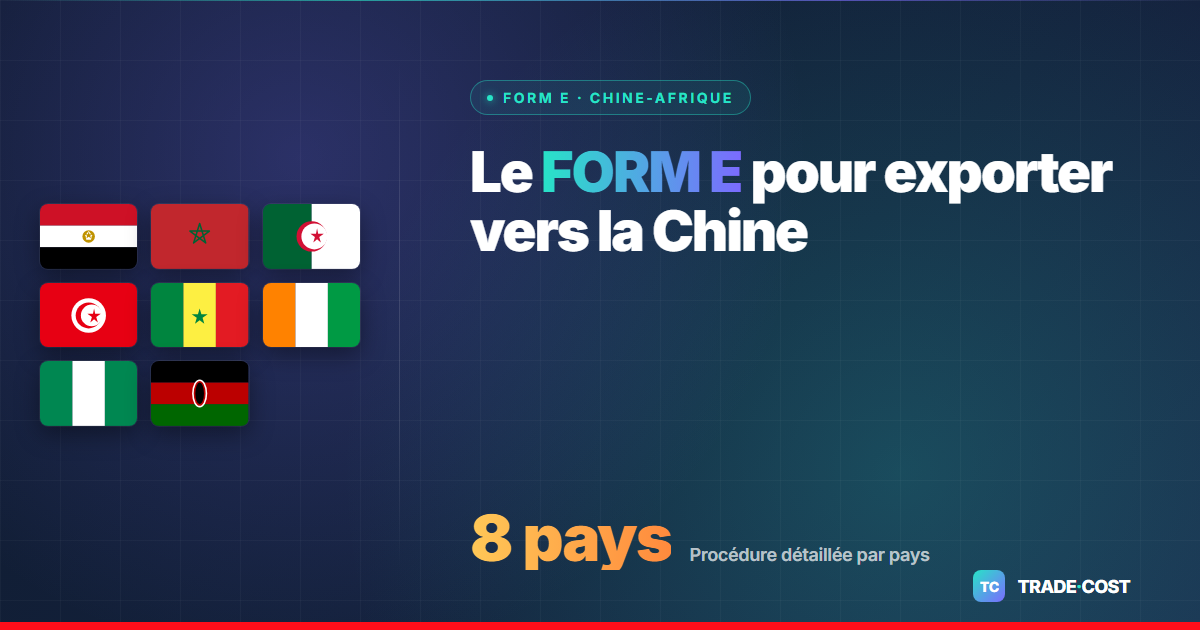
FORM E certificate of origin for export to China: the 2026 procedure for African exporters
Zero tariff does not trigger by itself
Many African exporters assume the 1 May 2026 measure applies automatically because their country is on the list of 53. That is an administrative illusion: when goods arrive at the Chinese port, the GACC officer does not consult an "eligible country" database. He reads one document: the certificate of origin. Without that valid and compliant paper, your container falls under the standard MFN tariff — even if you ship from Cairo or Dakar.
This article documents the real procedure country by country, with costs, lead times, issuing authorities and country-specific traps. Read it before your first post-May shipment.
FORM E vs non-preferential CO: which one?
Two documents are accepted by GACC to unlock the zero tariff:
- FORM E — preferential certificate under the FOCAC framework, pre-printed on a yellow-bordered form (front in French/English, back in Chinese). Standardized format, recognized by all FOCAC country customs. Recommended.
- Non-preferential Certificate of Origin (CO) — temporarily accepted by GACC. Free format following the issuing chamber's local practice.
The 14 February 2026 Chinese communiqué states that both documents are temporarily accepted "to avoid administrative friction at launch". Informal guidance to Chinese customs agents, however, favours FORM E for high-value shipments (above USD 50,000).
The procedure in 8 major African countries
Operational synthesis for the most active jurisdictions on the Africa-China route:
| Country | Issuing authority | Indicative cost | Standard turnaround |
|---|---|---|---|
| Egypt | Federation of Egyptian Industries (FEI) | ~ EGP 200 (USD 10) | 24 to 48 h |
| Morocco | CGEM / local chamber of commerce | MAD 300-500 (USD 30-50) | 48 h |
| Nigeria | NACCIMA + Nigeria Customs Service | ~ NGN 30,000 (USD 35) | 72 h |
| Kenya | KNCCI + Kenya Trade Network Agency | ~ KES 5,000 (USD 40) | 24 to 48 h |
| Ghana | Ghana Chamber of Commerce | ~ GHS 600 (USD 45) | 48 h |
| Côte d'Ivoire | CCI-CI (Abidjan) | XOF 25,000-50,000 (USD 40-80) | 48 to 72 h |
| South Africa | SACCI + SARS Customs | ZAR 800-1,500 (USD 45-80) | 48 h |
| Ethiopia | Addis Ababa Chamber of Commerce | ~ ETB 1,500 (USD 25) | 72 h |
Costs shown are for a standard certificate on a single shipment. Regular operators negotiate annual flat fees (30 to 50 % discount) and can obtain "approved exporter" status that authorizes self-certification in some countries (Mauritius, South Africa).
The document file you must produce
Across countries, the chamber of commerce systematically requests:
- Final commercial invoice with Incoterm, unit price, total value, seller/buyer details, HS code at minimum 6-digit level.
- Packing list detailing number of packages, gross weight, net weight, dimensions per carton.
- Bill of Lading (BL) or AWB showing port of loading and Chinese destination.
- Origin proof for the raw material: local supplier invoices (proof of wholly obtained) or production records (proof of substantial transformation).
- Exporter declaration of compliance certifying FOCAC rules of origin are met.
- For first-time application: company articles, trade register, tax ID, customs compliance certificate.
Five pitfalls that erase the zero tariff at arrival
1. HS code divergence between your country and GACC
By far the most common trap. The same canned tuna is classified 1604.14 by your local customs and 1604.20 by GACC. FORM E states the local code; GACC applies its own, which may land on an exclusion. Fix: request a Chinese Advance Ruling (free, 60 days) to lock the GACC code before first shipment.
2. Insufficient local value added
For a transformed product, FOCAC rules require at least 40 % local value added (material + labour + direct overhead). A t-shirt manufactured in Lagos from imported Chinese fabric only meets that bar if the fabric represents less than 60 % of EXW price. Run the math before investing in the chain.
3. Wrong port of loading
If FORM E states "port of loading: Lagos" but goods are actually loaded at Onne, GACC can reject the document for inconsistency with the BL. Verify that the port shown in FORM E box 11 matches exactly the port shown on the ocean BL.
4. Undocumented triangulation
If your goods transit through Dubai or Singapore before Shanghai, you must produce a "non-manipulation certificate" attesting that the goods underwent no transformation during the layover. Without that document, GACC treats origin as "UAE" or "Singapore" — automatic loss of zero tariff.
5. Chamber signature not registered with GACC
Each chamber of commerce files its authorized signature list with the Chinese embassy, which forwards it to GACC. An undeclared signatory change can block your certificates for 4 to 8 weeks. Confirm with your chamber that its GACC signature list is up to date, especially after an election or office reshuffle.
Worked example: Kenyan tea exporter
40' container = 22 t black tea, retail packs
FOB Mombasa = USD 78,000
HS code 0902.30 (verified via GACC Advance Ruling)
FORM E request to KNCCI: KES 5,000 + 24 h
File: invoice, BL, packing list, origin declaration, KTDA pickup records
FORM E issued D+1, vessel sailed D+4
Arrival Shanghai D+22, clearance with FORM E: 0 % duty
Saving versus 15 % MFN = USD 11,700 per container
Total FORM E procedure cost: USD 40. ROI: ~29,000 % per container. The cheapest, highest-leverage administrative step in international trade.
Verify the tariff applicable to your HS code
The TRADE-COST calculator cross-checks your HS code, African origin country and FOB value to display the exact Chinese tariff applying from 1 May 2026.
Run calculation →The right paper at the right time
FORM E is not a formality: it is the key that turns Beijing's political announcement into a real economic gain for your business. A poorly assembled file, a divergent HS code or an unregistered signature can wipe out a 14 or 17 % tariff edge. The exporters who will capture the differential are those who master the procedure on their very first May shipment.
To go further, read our full analysis of the China-Africa zero tariff, our exhaustive list of the 53 eligible countries, and our method for classifying a product into an HS code.
Frequently asked questions
What is the difference between FORM E and a standard non-preferential CO?+
FORM E is a preferential certificate of origin under the FOCAC framework, designed to unlock China's preferential access. It differs from a standard non-preferential CO on two points: it explicitly attests origin under FOCAC rules (40 % substantial transformation or 4-digit HS heading change), and it is pre-recognized by China customs (GACC). On 1 May 2026, Beijing confirmed existing FORM E certificates remain valid — no new form is required.
How much does a FORM E cost and how long does issuance take?+
Fees range from USD 10 to USD 80 depending on country and shipment value. In Egypt, the Federation of Egyptian Industries charges around EGP 200 (USD 10) for a standard certificate. In Nigeria, NACCIMA charges around NGN 30,000 (USD 35). In South Africa, the SACCI charges ZAR 800 to ZAR 1,500 (USD 45 to USD 80). Standard turnaround is 24 to 72 hours on a complete file; some chambers offer an express 2 to 4-hour service for an additional 50 to 100 % surcharge.
Can I obtain a FORM E retroactively after shipment?+
Yes, within 12 months from the shipment date. The procedure is called "Issued Retroactively" and requires an explicit notation on the form (FORM E box 13). GACC accepts retroactive certificates, but only if the origin was eligible at the time of shipment. Note: Chinese customs may request supporting evidence (upstream supplier invoices, production sheets) for late filings.
What if the HS classification on my FORM E differs from GACC classification?+
Classic dispute: the HS code declared by your country's chamber may differ from the one GACC applies on arrival. In a divergence, GACC applies its own classification, which can erase the zero-tariff benefit if it lands on an excluded code. The fix: request a GACC Advance Ruling BEFORE shipment to lock in the Chinese code, then have FORM E issued under that same code. Procedure is free, 60-day lead time.
My company operates from a free zone — am I still eligible?+
It depends on the level of transformation done in the zone. A free zone that just assembles Chinese components and re-ships to China does not create eligible African origin — that is circumvention, which Chinese customs actively police. By contrast, a free zone that transforms local raw materials (Egyptian cotton spun, woven and made up into apparel) with local value added above 40 % does create eligible origin. Document inbound flows precisely to defend your file in case of audit.
Marie Fontaine
Marie leads customs research at TRADE-COST. She spent eight years in tariff classification and post-clearance audits before joining the product team to turn customs expertise into software.
Calculate your landed cost in 30 seconds
Duties, VAT, freight, insurance and margin — one form, one complete result.
Try the calculator →The TRADE-COST newsletter
Once a month: our analyses on customs, freight, and changes in international trade rules. No spam, one-click unsubscribe.
By subscribing, you agree to receive our emails. One-click unsubscribe from every email.
Related articles
Outward Processing: Pay Duty Only on What Was Added Abroad
Outward processing lets you send goods abroad for repair, assembly or processing and pay import duty only on the value added outside your customs territory. HTSUS 9802.00.50/.60/.80 in the US, Outward Processing Relief in the UK, re-import notifications in India — plus the Section 301 trap and three worked examples in dollars.
End-Use and Actual-Use Relief: Paying Less Because of What You Do With the Goods
End-use is the only customs mechanism where the rate depends on the use, not the nature, of the goods. How EU end-use, US actual-use provisions (19 CFR 10.131), UK Authorised Use and India IGCR 2022 work — declarations, bonds, use windows, proof of use, and what happens on diversion. Three worked examples in USD.
Temporary Admission: Suspending Duty Without an ATA Carnet (2026)
Temporary admission is a customs procedure, not just an ATA carnet. Total vs partial relief at 3% per month, US Temporary Importation under Bond, UK TA, India section 74 drawback, bond sizing and the VAT trap. Three worked examples in $ and £.