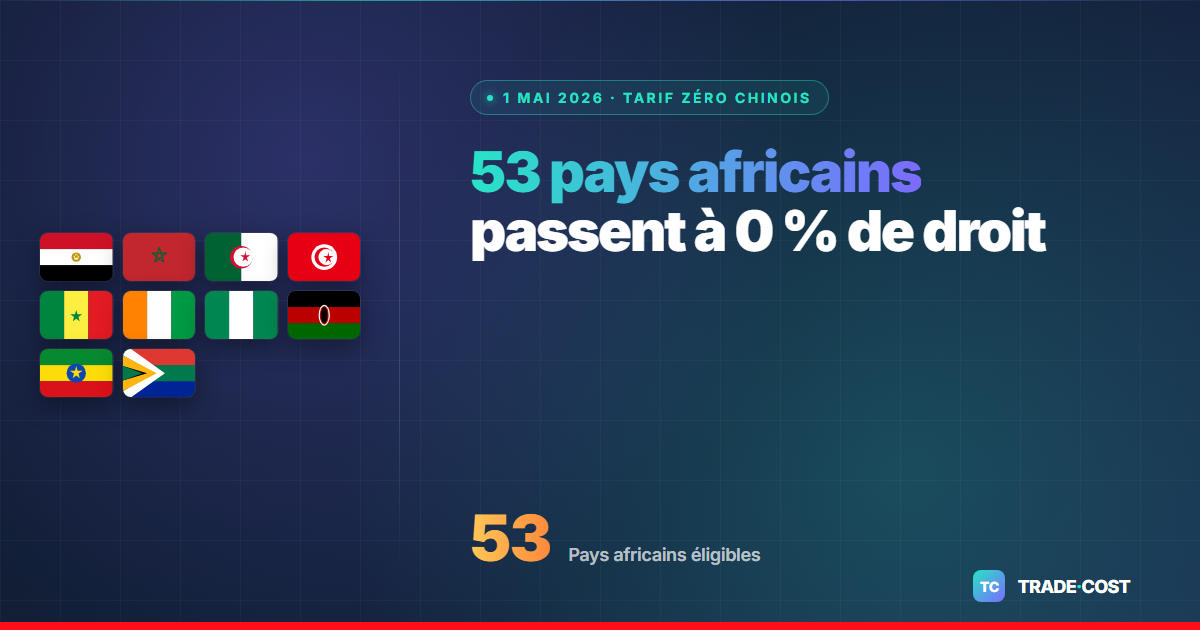
China zero-tariff regime: the full list of 53 eligible African countries (May 2026)
53 African countries, 1 excluded, 5 island states: the full map
The 14 February 2026 announcement has been picked up under the headline "zero tariff for Africa", but the exact perimeter remains foggy for many exporters. This article answers the simple question every export head asks first: is my country in?
The rule fits in one line: the full Chinese duty exemption applies to every African country holding active diplomatic relations with the People's Republic of China. Of the 54 states recognized by the African Union, 53 meet that test. One does not: eSwatini.
The tables below give the exhaustive country list by region, with a quick read on the export sectors most impacted by the measure in each country.
North Africa (7 countries)
| Country | ISO code | Main winning export sectors |
|---|---|---|
| Algeria | DZ | Petrochemicals, dates, cement, LNG |
| Egypt | EG | Cotton, textiles, citrus, fertilizers, cement |
| Libya | LY | Crude oil, petrochemical derivatives |
| Morocco | MA | Phosphates, citrus, apparel, canned fish |
| Mauritania | MR | Iron ore, frozen fish, gum arabic |
| Sudan | SD | Sesame, gum arabic, cotton, halal meat |
| Tunisia | TN | Olive oil, dates, apparel, phosphates |
West Africa (15 countries)
| Country | ISO code | Main winning export sectors |
|---|---|---|
| Benin | BJ | Cotton, pineapple, cashew |
| Burkina Faso | BF | Cotton, sesame, non-monetary gold |
| Cabo Verde | CV | Canned tuna |
| Côte d'Ivoire | CI | Cocoa, cashew, rubber, palm oil |
| Gambia | GM | Groundnuts, fish |
| Ghana | GH | Cocoa, gold, manganese, shea butter |
| Guinea | GN | Bauxite, alumina, coffee |
| Guinea-Bissau | GW | Cashew, fish |
| Liberia | LR | Rubber, iron ore, tropical timber |
| Mali | ML | Cotton, gold, sesame, gum arabic |
| Niger | NE | Uranium, onion, livestock |
| Nigeria | NG | Crude oil, leather, cocoa, sesame, rubber |
| Senegal | SN | Phosphates, groundnuts, fish, gum arabic |
| Sierra Leone | SL | Bauxite, rutile, cocoa |
| Togo | TG | Phosphates, cotton, cement, cocoa |
Central Africa (8 countries)
| Country | ISO code | Main winning export sectors |
|---|---|---|
| Cameroon | CM | Cocoa, coffee, banana, rubber, timber |
| Central African Republic | CF | Timber, coffee, cotton, rough diamonds |
| Chad | TD | Cotton, gum arabic, sesame |
| Congo (Brazzaville) | CG | Crude oil, tropical timber, manganese |
| DR Congo (Kinshasa) | CD | Cobalt, copper, coffee, palm oil |
| Equatorial Guinea | GQ | Crude oil, methanol, timber |
| Gabon | GA | Crude oil, manganese, okoumé timber |
| São Tomé and Príncipe | ST | Cocoa, palm oil, fish |
East Africa (14 countries)
| Country | ISO code | Main winning export sectors |
|---|---|---|
| Burundi | BI | Coffee, tea, coltan |
| Comoros | KM | Vanilla, ylang-ylang, cloves |
| Djibouti | DJ | Salt, regional logistics hub |
| Eritrea | ER | Gold, granite, sesame |
| Ethiopia | ET | Coffee, cut flowers, pulses, leather |
| Kenya | KE | Tea, coffee, flowers, fresh produce, avocado |
| Madagascar | MG | Vanilla, cloves, apparel, nickel, cobalt |
| Mauritius | MU | Refined sugar, premium textiles, financial services |
| Rwanda | RW | Coffee, tea, coltan, made-in-Africa apparel |
| Seychelles | SC | Canned tuna, vanilla |
| Somalia | SO | Livestock, frankincense, charcoal |
| South Sudan | SS | Crude oil, gum arabic |
| Tanzania | TZ | Gold, coffee, cashew, sisal, tobacco |
| Uganda | UG | Coffee, tea, Nile perch, flowers |
Southern Africa (9 countries)
| Country | ISO code | Main winning export sectors |
|---|---|---|
| Angola | AO | Crude oil, diamonds, iron, LNG |
| Botswana | BW | Diamonds, beef, leather |
| Lesotho | LS | Apparel, water, diamonds |
| Malawi | MW | Tobacco, tea, sugar, pulses |
| Mozambique | MZ | LNG, coal (excluded), aluminium, cashew |
| Namibia | NA | Diamonds, uranium, beef, fish |
| South Africa | ZA | Citrus, wine, automotive, iron, coal (excluded) |
| Zambia | ZM | Copper, honey, coffee, sugar |
| Zimbabwe | ZW | Tobacco, lithium, ferro-alloys, citrus |
The single excluded state: eSwatini
eSwatini (formerly Kingdom of Swaziland) is the last African state recognizing the Republic of China (Taiwan) instead of the People's Republic of China. It belongs to the dozen states worldwide that maintain diplomatic relations with Taipei. Beijing's position is unambiguous: no preferential treatment goes to a state that does not recognize the PRC as the sole legitimate government of China.
Concrete consequence: an eSwatini sugar or apparel exporter to mainland China keeps paying the standard MFN tariff (up to 50 % on sugar, 14 % on cotton t-shirts) while its South African neighbour drops to 0 % on 1 May. The gap will likely fuel an internal political debate in Mbabane in the coming months.
Three cumulative conditions to qualify
Being headquartered in one of the 53 countries is not enough. Three cumulative conditions must be met:
- Product origin must be African under FOCAC rules of origin. Either wholly obtained (raw agricultural commodity, mineral) or having undergone substantial transformation (4-digit HS heading change or local value added of at least 40 %). A Chinese product transiting through an African country does not become African.
- A valid certificate of origin must accompany the goods. FORM E under FOCAC, or a Certificate of Origin issued by the national chamber of commerce or local customs. Without that document, GACC defaults to the MFN tariff.
- The product must not appear in the confirmed exclusions. Coal (3 to 6 %) stays tariffed. Goods under live anti-dumping measures keep their additional rates. See our main article on the announcement for full detail.
Compute your landed cost into China
Pick your country among the 53 eligible, your HS code and your FOB value. The engine applies the zero rate automatically from 1 May 2026.
Run calculation →A continental map that redraws the flows
Beyond the listing, the political message matters: China treats the 53 African countries as a single preferential bloc, with no PIB or LDC-status hierarchy. That is a break with the standard WTO model where the most-favoured-nation principle leaves little room for origin-based differentiation. For a Chinese importer, the buying reflex shifts mechanically: at equal quality, sourcing from Africa becomes 5 to 17 % cheaper than from Vietnam, India or Pakistan.
To dig deeper, read our full analysis of the 14 February 2026 announcement, our guide to classifying a product into an HS code, and our de minimis 2026 country brief to understand how exemption thresholds stack with the new China zero tariff.
Frequently asked questions
Why 53 and not 54 — who is excluded?+
eSwatini (formerly Swaziland) is the only African state that maintains diplomatic relations with Taiwan rather than the People's Republic of China. Beijing conditions any preferential treatment on its diplomatic recognition, so eSwatini is de facto excluded from the zero-tariff regime. If eSwatini ever switches recognition to Beijing, the extension would most likely be automatic.
Are middle-income countries treated identically to LDCs in this regime?+
Yes, in full. The official communiqué of the Chinese State Council from 14 February 2026 makes no distinction between development levels: the coverage is identical for Least Developed Countries and middle-income economies. Egypt, Morocco, Nigeria, Kenya and South Africa now sit at the same eligibility level as Burkina Faso or Mozambique. That parity is precisely the headline change versus the prior FOCAC arrangement.
Are the African island economies included?+
Yes, without exception. Mauritius, Seychelles, Cabo Verde, the Comoros and São Tomé and Príncipe — five island states — all hold active diplomatic relations with Beijing and are fully included. For Mauritius specifically, which already has a 2019 bilateral free-trade agreement with China covering 96 % of tariff lines, the 2026 measure consolidates and extends the arrangement to the remaining 4 %.
What about Western Sahara and other contested territories?+
The Sahrawi Arab Democratic Republic is not recognized by China and does not appear in the list of 53. Goods presented for Chinese clearance with a Western Sahara origin will be treated under the Moroccan regime to the extent that Beijing acknowledges Moroccan sovereignty over the area (de facto position since 2020). In practice, a Moroccan chamber of commerce certificate of origin covers products from southern Morocco.
Does the product need to be locally transformed to qualify for African origin?+
Yes. FOCAC rules of origin still apply: a product must be either wholly obtained in the African country (raw agricultural commodities, minerals) or have undergone a substantial transformation (4-digit HS heading change or local value added of at least 40 %). Importing a Chinese television into Algeria for re-export to China does not qualify for the zero tariff: the local transformation must be real and documented.
Hicham El Mansouri
Hicham covers African trade corridors — from Maghreb gateways to Sub-Saharan markets and the FOCAC framework. He worked with Moroccan ADII and Algerian customs before scaling cross-border e-commerce operations across the continent.
Calculate your landed cost in 30 seconds
Duties, VAT, freight, insurance and margin — one form, one complete result.
Try the calculator →The TRADE-COST newsletter
Once a month: our analyses on customs, freight, and changes in international trade rules. No spam, one-click unsubscribe.
By subscribing, you agree to receive our emails. One-click unsubscribe from every email.
Related articles
Outward Processing: Pay Duty Only on What Was Added Abroad
Outward processing lets you send goods abroad for repair, assembly or processing and pay import duty only on the value added outside your customs territory. HTSUS 9802.00.50/.60/.80 in the US, Outward Processing Relief in the UK, re-import notifications in India — plus the Section 301 trap and three worked examples in dollars.
End-Use and Actual-Use Relief: Paying Less Because of What You Do With the Goods
End-use is the only customs mechanism where the rate depends on the use, not the nature, of the goods. How EU end-use, US actual-use provisions (19 CFR 10.131), UK Authorised Use and India IGCR 2022 work — declarations, bonds, use windows, proof of use, and what happens on diversion. Three worked examples in USD.
Temporary Admission: Suspending Duty Without an ATA Carnet (2026)
Temporary admission is a customs procedure, not just an ATA carnet. Total vs partial relief at 3% per month, US Temporary Importation under Bond, UK TA, India section 74 drawback, bond sizing and the VAT trap. Three worked examples in $ and £.