China zero-tariff for 53 African countries — what changes on 1 May 2026
An announcement that rewrites the China-Africa tariff grid
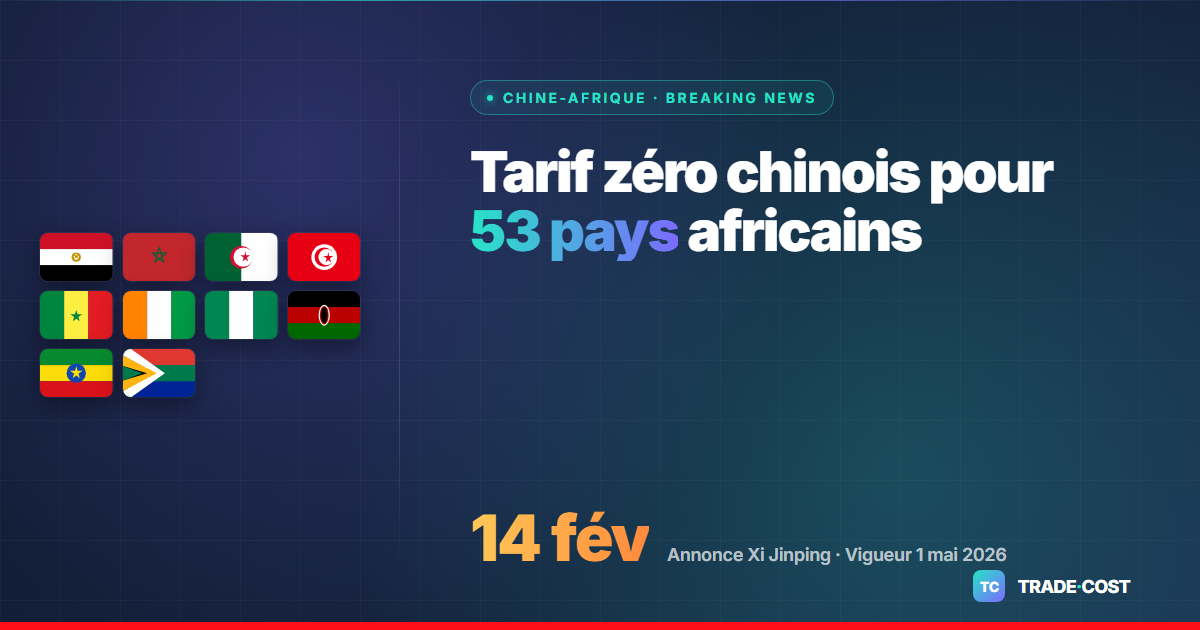
On 14 February 2026, President Xi Jinping confirmed that China would apply, from 1 May 2026, zero customs duty across the entire tariff schedule to goods originating from the 53 African countries holding diplomatic relations with Beijing. The measure comes with no global quotas and no additional political conditions: it is the broadest market opening China has ever granted to an entire continent (source: PRC State Council communiqué, 14 February 2026; coverage by APA, Agence Ecofin, china.org.cn).
For middle-income African economies — Egypt, Nigeria, Kenya, South Africa, Morocco — the leap is concrete: until now they paid the full Chinese MFN tariff, which peaks at 25 % on selected apparel, food and furniture lines. On 1 May, that wall comes down.
Exact scope: who, what, when
Three operational questions drive an exporter's strategy:
- Who? The 53 African countries with active diplomatic relations with Beijing (eSwatini, which keeps relations with Taipei, is excluded). Every other state — from Cairo to Lagos, from Casablanca to Mombasa — is eligible the moment origin is proven.
- What? 100 % of tariff lines, with one confirmed exception: coal (anthracite, coking, bituminous) keeps a 3 to 6 % duty depending on grade. Non-tariff regulations (sanitary standards, mandatory labelling, CCC certifications for electrotech) stay unchanged.
- When? Full application from 1 May 2026. Goods presented for Chinese clearance on or after that date with a valid certificate of origin automatically benefit from the zero rate, with no prior formality.
Important: this measure covers Chinese imports coming from Africa, not the reverse. Your imports from China into Egypt, Kenya or Nigeria remain subject to your national tariff schedule unchanged.
Before vs after, line by line
Synthetic comparison of Chinese 2025 MFN tariffs versus the regime opened on 1 May 2026 for African middle-income economies (source: China Customs Tariff Schedule 2026, WTO Tariff Profiles):
| Product | HS code | MFN tariff (before) | Tariff from 01/05/2026 |
|---|---|---|---|
| Virgin olive oil (origin MA, TN) | 1509.10 | 10 % | 0 % |
| Calcium phosphates | 2510.20 | 3 % | 0 % |
| Raw cotton (origin EG) | 5201.00 | 1 % in TRQ / 40 % out of TRQ | 0 % all lines |
| Cotton t-shirts | 6109.10 | 14 % | 0 % |
| Canned tuna | 1604.14 | 15 % | 0 % |
| Cocoa beans (origin CI, GH) | 1801.00 | 2 % | 0 % |
| Coffee beans (origin ET, KE) | 0901.21 | 8 % | 0 % |
| Sisal and hard fibres | 5304.10 | 3 % | 0 % |
| Anthracite coal | 2701.11 | 3 % | 3 % (excluded) |
Read it like this: on apparel and processed agri-food, the jump is massive (10 to 15 duty points eliminated). On lightly taxed raw materials, the gain is marginal but useful in a tight competitive race. Coal stays out of scope.
Three concrete worked examples
Example 1: Kenyan coffee exporter (FOB Mombasa to Shanghai)
40' container = 18 t green Arabica
FOB value = USD 95,000 (March 2026 spot ~5,300 USD/t)
Before 01/05: duty 8 % + import VAT 9 % = 7,600 + 9,234 = USD 16,834
From 01/05: duty 0 % + import VAT 9 % = 0 + 8,550 = USD 8,550
Saving per container = ~ USD 8,284 (-49 % in entry tax)
Eight-thousand-dollar savings per container land directly on the trader margin or in price reduction to Chinese roasters who are currently sourcing Vietnamese robusta or Brazilian arabica. On a quarterly volume of 30 containers, the line is north of a quarter-million USD.
Example 2: Nigerian leather exporter (Lagos to Guangzhou)
Wet-blue cattle leather, 25 t shipment
FOB value = USD 120,000
Before 01/05: duty 5 % = USD 6,000
From 01/05: duty 0 % = USD 0
Saving per shipment = USD 6,000
The Nigerian tannery sector has long competed with Pakistani and Indian wet-blue. Removing the 5 % Chinese duty is enough to flip several Guangdong shoe manufacturers' sourcing decisions toward Lagos for mid-tier grades.
Example 3: South African citrus shipment (Cape Town to Tianjin)
Reefer 40' = 24 t fresh oranges
FOB value = USD 38,000
Before 01/05: duty 11 % = USD 4,180
From 01/05: duty 0 % = USD 0
Saving per reefer = USD 4,180
South African citrus competes head-on with Egyptian fruit (now also at 0 %) and with Australian and Spanish supply (still at 11 %). The price moves enough to redraw the Northern Hemisphere off-season citrus map for Chinese buyers in 2026-27.
The export checklist to run before 1 May
Four concrete actions to execute this week if you target the Chinese market:
- Lock in the certificate of origin. Your national chamber of commerce (FNCCI in Egypt, NACCIMA in Nigeria, KNCCI in Kenya) issues the document. Plan ahead — application volume will spike in early May, book your slots now.
- Verify the Chinese HS classification. The zero tariff applies to the tariff line as classified by GACC (Chinese customs). A mismatch between your domestic and Chinese classification can erase the benefit. Pre-classify through a Chinese customs broker or a GACC Advance Ruling.
- Align on non-tariff requirements. Zero duty does not mean free access: agri-food = CIFER registration, electrotech = CCC certification, cosmetics = NMPA filing. These take 3 to 9 months — start now.
- Recompute your landed cost. With duty at zero, your theoretical margin grows by 5 to 17 %. Decide whether to capture the gain in net margin or reinject it in price to grab market share against non-African competitors.
Recompute your landed cost into China
Pick origin (Egypt, Nigeria, Kenya, South Africa, Morocco, Côte d'Ivoire…), destination China, HS code and FOB value. The calculator applies the new zero tariff automatically from 1 May 2026.
Run calculation →A strategic window, not an automatic windfall
Zero tariff is a powerful lever, but it does not create exports on its own. The exporters who will capture the most upside are those who have prepared the file in advance: documented origin, validated Chinese HS classification, anticipated sanitary and technical standards, and a price strategy calibrated on the new landed cost. Countries that simply notice the opening will see the differential captured by forwarders and local distributors instead.
To go further, read our guide to classifying a product into an HS code, our method to compute customs duty from a tariff and a value, and our de minimis 2026 country brief to understand the other exemption thresholds that stack with the new China zero tariff.
Frequently asked questions
Is my company automatically eligible or do I have to apply?+
No individual application is required. The measure applies automatically from 1 May 2026 to any goods cleared in China with a proof of origin from one of the 53 eligible African countries. In practice the Egyptian, Nigerian or Kenyan exporter must produce a certificate of origin issued by the national chamber of commerce or customs administration. China customs verifies origin compliance — once validated, the 0 % rate applies automatically on the relevant HS line.
Does zero tariff cover absolutely every product?+
The official communiqué speaks of 100 % tariff-line coverage, but a confirmed exception applies to coal: anthracite and coking coal keep a 3 % duty, certain bituminous grades 5 to 6 %, per Chinese 2026 customs schedules. Goods regulated through non-tariff measures (sanitary, phytosanitary, mandatory GB standards, TRQ on sugar and cotton) remain framed as before. In short: zero customs duty, but AQSIQ, GACC and CCC requirements still apply.
Which sectors will benefit the most?+
For Egypt, Morocco and Tunisia: olive oil, citrus, processed fish, processed phosphates and apparel gain an immediate 8 to 17 % price advantage over non-African competitors. For Nigeria: processed agri-food, leather and apparel exit the standard MFN grid. For Kenya and Ethiopia: coffee, tea, cut flowers and horticulture move from 8 % MFN to 0 %. For Côte d'Ivoire and Ghana: cocoa derivatives gain 2 to 5 points of margin. The benefit is marginal on crude hydrocarbons (already lightly taxed) and excluded for coal.
Didn't most African countries already have preferential access via FOCAC?+
Only the African Least Developed Countries (LDCs) had it. Under the previous FOCAC arrangement, only LDC African countries enjoyed duty-free access on 98 % of tariff lines. Middle-income economies — Egypt, Morocco, Nigeria, Kenya, South Africa — paid the full Chinese MFN tariff, which can reach 25 % on apparel or processed food lines. The 1 May 2026 reform is precisely the extension of duty-free treatment to those middle-income countries.
What origin certificate do I need to file at Chinese customs?+
For most African countries, a non-preferential certificate of origin issued by the national chamber of commerce (or by customs in countries with centralized issuance) is enough. China requests a classic FORM E as used under FOCAC, or a Certificate of Origin (CO) accompanied by the commercial invoice and the bill of lading. As of April 2026, no specific new "2026 zero tariff" form has been announced — Beijing has indicated that implementation will rely on existing certificates to avoid administrative friction at launch.
Hicham El Mansouri
Hicham covers African trade corridors — from Maghreb gateways to Sub-Saharan markets and the FOCAC framework. He worked with Moroccan ADII and Algerian customs before scaling cross-border e-commerce operations across the continent.
Calculate your landed cost in 30 seconds
Duties, VAT, freight, insurance and margin — one form, one complete result.
Try the calculator →The TRADE-COST newsletter
Once a month: our analyses on customs, freight, and changes in international trade rules. No spam, one-click unsubscribe.
By subscribing, you agree to receive our emails. One-click unsubscribe from every email.
Related articles
Outward Processing: Pay Duty Only on What Was Added Abroad
Outward processing lets you send goods abroad for repair, assembly or processing and pay import duty only on the value added outside your customs territory. HTSUS 9802.00.50/.60/.80 in the US, Outward Processing Relief in the UK, re-import notifications in India — plus the Section 301 trap and three worked examples in dollars.
End-Use and Actual-Use Relief: Paying Less Because of What You Do With the Goods
End-use is the only customs mechanism where the rate depends on the use, not the nature, of the goods. How EU end-use, US actual-use provisions (19 CFR 10.131), UK Authorised Use and India IGCR 2022 work — declarations, bonds, use windows, proof of use, and what happens on diversion. Three worked examples in USD.
Temporary Admission: Suspending Duty Without an ATA Carnet (2026)
Temporary admission is a customs procedure, not just an ATA carnet. Total vs partial relief at 3% per month, US Temporary Importation under Bond, UK TA, India section 74 drawback, bond sizing and the VAT trap. Three worked examples in $ and £.