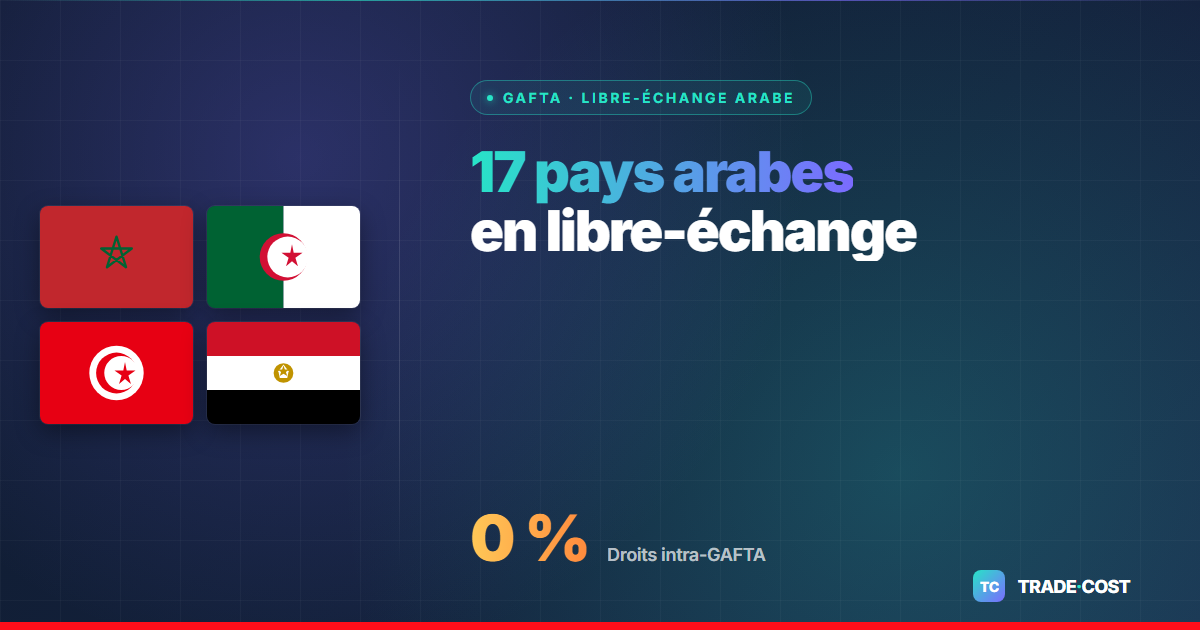
GAFTA Agreement: Greater Arab Free Trade Area Guide
Introduction: GAFTA, an underutilised lever for intra-Arab trade
The Greater Arab Free Trade Area, commonly known as GAFTA, is one of the most significant trade agreements in the world by the number of countries covered — and yet one of the most underexploited by international trade operators.
Bringing together all 22 members of the Arab League, GAFTA theoretically provides duty-free access to a market of more than 420 million consumers, with a combined GDP exceeding USD 2,800 billion. Yet intra-Arab trade represents only 10 to 12% of total trade of the member countries — an abnormally low figure compared to the 60% of intra-European trade.
This guide details everything you need to know to concretely benefit from GAFTA: member countries, tariff elimination schedule, rules of origin, required certificates, product coverage, exceptions, and practical trade examples between Morocco, Egypt and Saudi Arabia.
History and legal framework of GAFTA
From origins to entry into force
The idea of an Arab free trade area dates back to the 1950s, but it was in 1997 that the Economic and Social Council of the Arab League adopted the Executive Programme for the Agreement on Facilitation and Development of Inter-Arab Trade. The agreement came into force on 1 January 1998, with a progressive tariff reduction schedule of 10% per year.
The programme initially planned for complete elimination of customs duties over 10 years (2008). However, an acceleration was decided in 2001, bringing the deadline forward to 1 January 2005. Since that date, customs duties between member countries have been theoretically at 0% for all products complying with the rules of origin.
The legal framework
GAFTA rests on three fundamental legal pillars:
- The Inter-Arab Trade Facilitation Agreement (1981): the founding text, signed by members of the Arab League.
- The Executive Programme (1997): the operational mechanism for progressive tariff reduction.
- The Unified Arab Rules of Origin (2004): the 40% local value-added criterion conditioning preferential access.
The agreement is supervised by the GAFTA Monitoring Committee within the Arab League, which meets regularly to settle trade disputes between members and update technical annexes.
The 22 member countries: a massive and heterogeneous market
GAFTA covers all countries of the Arab League. Here is a comprehensive overview with their economic weight:
| Region | Country | GDP (Bn USD) | Population (M) |
|---|---|---|---|
| Gulf (GCC) | Saudi Arabia | 1,061 | 36 |
| UAE | 507 | 10 | |
| Qatar | 220 | 3 | |
| Kuwait | 160 | 4.5 | |
| Oman | 105 | 5 | |
| Bahrain | 44 | 1.5 | |
| North Africa | Egypt | 400 | 106 |
| Algeria | 195 | 46 | |
| Morocco | 140 | 37 | |
| Tunisia | 48 | 12 | |
| Libya | 42 | 7 | |
| Levant | Iraq | 265 | 44 |
| Jordan | 47 | 11 | |
| Lebanon | 22 | 5.5 | |
| Syria | 12 | 22 | |
| Africa / Other | Sudan | 26 | 48 |
| Yemen | 21 | 34 | |
| Mauritania | 10 | 5 | |
| Djibouti | 4 | 1 | |
| Somalia | 8 | 18 | |
| Territories | Palestine, Comoros | — | — |
Key point: the six Gulf Cooperation Council (GCC) countries alone represent more than 60% of the total GAFTA zone GDP. Egypt dominates by population (106 million), making it the largest consumer market in the area.
The tariff elimination schedule
Reduction phases
Tariff elimination under GAFTA unfolded in two major phases:
| Period | Annual reduction | Residual duties | Note |
|---|---|---|---|
| 1998-2001 | 10% per year | 60% of initial rate | Slow initial phase |
| 2002-2004 | 20% per year | Being eliminated | Acceleration decided in 2001 |
| 2005-present | N/A | 0% | Full elimination (compliant products) |
Since 1 January 2005, customs duties have officially been at 0% for all products complying with the rules of origin. However, it is crucial to understand that this elimination does not cover all barriers: member countries retain the right to apply domestic taxes (VAT, consumption tax), technical standards, and sanitary and phytosanitary measures.
Persistent non-tariff barriers
One of the major challenges of GAFTA is the persistence of non-tariff barriers that limit the real impact of tariff elimination:
- Divergent technical standards: each country maintains its own product standards, often not harmonised with other members.
- Heavy customs procedures: despite tariff exemption, customs clearance time can exceed 7 days in some countries (vs 1-2 days in the GCC).
- Sanitary restrictions: occasional bans on agricultural products for health reasons sometimes serve as disguised protectionism.
- Import licences: Algeria and Egypt maintain import licensing regimes on certain products that slow trade.
Calculate your customs duties between Arab countries
Our simulator integrates GAFTA preferential agreements. Instantly check whether your product benefits from tariff exemption between member countries.
Simulate my duties →GAFTA rules of origin: the 40% criterion
The fundamental principle
For a product to benefit from GAFTA tariff exemption, it must satisfy the rule of origin of 40% local value added. This means that at least 40% of the finished product's value must originate from the exporting Arab country. The calculation formula is as follows:
Local value added (%) = [(FOB price - Value of imported materials) / FOB price] × 100 ≥ 40%
Local value added includes:
- The cost of local raw materials (or from cumulative Arab origin)
- Labour costs, both direct and indirect
- Manufacturing costs: energy, machine depreciation, maintenance
- Packaging costs carried out locally
- The manufacturer's profit margin
Origin cumulation between Arab countries
One of the most advantageous aspects of GAFTA is the possibility of bilateral origin cumulation. If a product is manufactured in one Arab country using components from another Arab country, the added values are combined. For example:
Tunisian fabric (15%) + Moroccan manufacturing (28%) = 43% ≥ 40% → COMPLIANT
This cumulation mechanism is particularly useful for regional value chains, where different production stages are distributed across several Arab countries. It encourages the creation of integrated production chains within the zone.
Exceptions and special cases
Certain product categories benefit from simplified or reinforced rules of origin:
- Wholly obtained products: agricultural, mineral and fishery products entirely produced in an Arab country are automatically compliant, without percentage calculation.
- Assembled products: simple assembly or packaging does not confer GAFTA origin. Substantial transformation is required.
- Excluded minimal operations: sorting, cleaning, simple painting, bottling and labelling do not count as value added.
The GAFTA certificate of origin: procedure and documents
How to obtain the certificate
The GAFTA certificate of origin is the key document for benefiting from the tariff exemption. Here is the step-by-step procedure:
- Prepare your file: gather the commercial invoice, packing list, proof of raw material purchases (supplier invoices), and cost accounting demonstrating local value added.
- Submit to the Chamber of Commerce: submit the file to the chamber of commerce and industry in your country. Some countries (Morocco, Tunisia) allow online submission.
- Verification and validation: the chamber of commerce verifies compliance with rules of origin. The timeframe is generally 1 to 3 business days.
- Consular legalisation: some importing countries (Saudi Arabia, Kuwait) require legalisation of the certificate by the consulate of the destination country. Allow 3 to 5 additional days and fees of USD 50 to 200.
- Customs presentation: the certificate of origin is presented with shipping documents to the importing country's customs to benefit from the 0% preferential rate.
Required information on the certificate
The GAFTA certificate of origin must mandatorily state:
- Name and address of the exporter and importer
- Precise description of the goods and the HS code (Harmonised System)
- Country of origin and country of destination
- Percentage of local value added (minimum 40%)
- Number and date of the commercial invoice
- Stamp and signature of the issuing chamber of commerce
Product coverage and exceptions
Products covered by GAFTA
In theory, GAFTA covers all products in the customs tariff, both industrial and agricultural. The main beneficiary sectors are:
- Textiles and clothing: a dynamic sector in intra-Arab trade, with value chains between Tunisia, Morocco and Egypt.
- Agri-food: cereals, oils, canned goods, dairy products, dates and dried fruits.
- Construction materials: cement, ceramics, steel, aluminium — a crucial sector for infrastructure projects in the Gulf.
- Chemical products: fertilisers, plastics, paints, cleaning products.
- Equipment and machinery: household appliances, electrical cables, furniture.
Exclusions: tobacco, alcohol and sensitive products
The main permanent exclusions from GAFTA are:
| Excluded category | Reason | Note |
|---|---|---|
| Tobacco and tobacco products | Public health / state monopolies | Excluded in all member countries |
| Alcoholic beverages | Religious legislation | Banned or heavily taxed in most countries |
| Weapons and ammunition | National security | Specific authorisation regime |
| Sensitive agricultural products (national list) | Protection of local producers | Varies by country, progressively decreasing |
| Vehicles (in some countries) | Tax revenue | Algeria and Egypt maintain restrictions |
Impact on intra-Arab trade flows
Tangible but insufficient growth
Since GAFTA came into force, intra-Arab trade has experienced significant growth, rising from USD 30 billion in 1998 to approximately USD 150 billion in 2025. However, this figure remains modest compared to the potential:
- Intra-Arab trade represents only 10 to 12% of total trade of member countries.
- For comparison, intra-EU trade represents 60%, intra-ASEAN 25%, and intra-Mercosur 15%.
- Oil and gas products still largely dominate intra-Arab trade, limiting diversification.
The main trade corridors
Intra-GAFTA trade flows are dominated by three major corridors:
- Gulf → North Africa: oil, natural gas, petrochemical products, aluminium. Saudi Arabia and the UAE are the largest intra-Arab exporters.
- North Africa → Gulf: agricultural products (citrus, olives), textiles, construction materials. Egypt and Morocco are the main suppliers.
- Jordan-Iraq-Lebanon: a historic trade axis for food products, chemicals and construction materials.
How to concretely benefit from GAFTA
Practical steps
Here is a step-by-step guide to leveraging GAFTA in your import-export operations:
- Verify eligibility: confirm that your product is not on the exclusion list of the destination country. Consult the national customs tariff or contact customs.
- Calculate value added: verify that your product reaches the 40% local value-added threshold. Do not forget about origin cumulation with other Arab countries.
- Obtain the certificate of origin: submit your file to the relevant chamber of commerce. Anticipate consular legalisation delays if necessary.
- Prepare your documents: commercial invoice, packing list, GAFTA certificate of origin, bill of lading, and any technical or sanitary certificate required by the destination country.
- Declare at the preferential rate: upon customs clearance, present the certificate of origin to benefit from the 0% rate. Ensure your freight forwarder knows the GAFTA procedure.
Common mistakes to avoid
The main reasons for rejection of GAFTA preferential treatment are:
- Non-compliant certificate of origin (missing information, illegible stamp)
- Value added below 40% after customs verification
- Product excluded from the GAFTA list in the destination country
- Certificate not legalised by the consulate (when legalisation is required)
- HS classification error between the certificate and the customs declaration
To avoid customs classification errors, consult our complete HS code guide.
Comparison with other regional free trade agreements
How does GAFTA compare with other agreements in the region?
| Agreement | Members | Rule of origin | Residual duties | Intra-zone trade |
|---|---|---|---|---|
| GAFTA | 22 Arab countries | 40% value added | 0% | ~12% of total |
| Agadir Agreement | 4 (Morocco, Tunisia, Egypt, Jordan) | 40% + Pan-Euro-Med cumulation | 0% | 3-4% of total |
| GCC Customs Union | 6 Gulf countries | 40% (GCC origin) | 0% + 5% CET | ~8% of total |
| AMU (Maghreb) | 5 (Algeria, Libya, Morocco, Mauritania, Tunisia) | Non-operational | Variable | < 3% |
| AfCFTA | 54 African countries | Variable by product | Being eliminated | ~15% of total |
Strategic point: the Agadir Agreement is complementary to GAFTA and offers the advantage of Pan-Euro-Mediterranean origin cumulation, allowing the use of European inputs while maintaining preferential treatment. A Moroccan exporter can thus use Spanish fabric and export the finished garment to Jordan duty-free.
Practical examples: Morocco-Egypt-Saudi Arabia
Example 1: Export of canned olives from Morocco to Saudi Arabia
A Moroccan producer of canned olives wishes to export to Saudi Arabia:
| Item | Detail |
|---|---|
| FOB value | USD 10,000 |
| Imported materials (glass jars, Turkey) | USD 2,000 (20%) |
| Moroccan olives + labour + manufacturing | USD 8,000 (80%) |
| Local value added | 80% ≥ 40% → GAFTA COMPLIANT |
| Normal customs duty (Saudi Arabia) | 5% = USD 500 |
| Duty with GAFTA | 0% = USD 500 savings |
Example 2: Import of Egyptian ceramics to Morocco
A Moroccan importer purchases ceramic tiles manufactured in Egypt:
| Item | Detail |
|---|---|
| CIF Casablanca value | USD 50,000 |
| Imported components (Italian glazes) | USD 12,000 (24%) |
| Egyptian clay + manufacturing + labour | USD 38,000 (76%) |
| Local value added | 76% ≥ 40% → GAFTA COMPLIANT |
| Normal customs duty (Morocco) | 25% = USD 12,500 |
| Duty with GAFTA | 0% = USD 12,500 savings |
Example 3: Textile value chain Tunisia-Egypt-Saudi Arabia
An intra-Arab value chain scenario with origin cumulation:
- Tunisia: cotton yarn production (20% value added of the final product)
- Egypt: weaving and garment manufacturing (35% value added of the final product)
- Export to Saudi Arabia: origin cumulation = 20% + 35% = 55% ≥ 40% → COMPLIANT
Raw materials imported outside the Arab zone (chemical dyes from India): 45% of the final product. Thanks to cumulation, the chain is compliant even though neither country alone would have reached 40% without the other's contribution.
Estimate the GAFTA savings on your next shipment
Compare your total cost with and without GAFTA: customs duties, VAT, freight and insurance included in a single calculation.
Calculate my landed cost →GAFTA and the GCC Customs Union
The six Gulf countries (Saudi Arabia, UAE, Qatar, Kuwait, Oman, Bahrain) belong to both GAFTA and the GCC Customs Union, which came into force in 2003. The GCC Customs Union applies a Common External Tariff (CET) of 5% on imports from third countries.
In practice, this means:
- A GAFTA-compliant Arab product enters any GCC country at 0%.
- A non-Arab product enters the GCC at the 5% CET (with exceptions: tobacco 100%, sugary drinks 50%).
- Once cleared through customs in one GCC country, the product circulates freely between the six member countries without additional duties.
This dual membership creates a strategic advantage for Arab exporters: a GAFTA-compliant Moroccan product, once entered in the UAE, can be re-exported to Saudi Arabia or Qatar without additional customs formalities.
Outlook for GAFTA's evolution
Several initiatives are underway to strengthen GAFTA's effectiveness:
- Digitalisation of certificates of origin: several countries (UAE, Jordan, Morocco) are developing electronic platforms for issuing and verifying certificates, reducing delays and fraud risks.
- Standards harmonisation: AIDMO (Arab Industrial Development and Mining Organisation) is working on harmonising technical standards between member countries.
- Reducing non-tariff barriers: the Arab League has launched a non-tariff barrier monitoring programme, with a complaints mechanism for operators.
- Integration with AfCFTA: African Arab countries (Egypt, Morocco, Tunisia, Algeria) could benefit from a bridge between GAFTA and the African Continental Free Trade Area.
Conclusion: GAFTA, a tool to leverage for any Arab trade operator
GAFTA remains a underutilised agreement despite its considerable potential. The elimination of customs duties between 22 countries representing more than 420 million consumers offers real savings opportunities for importers and exporters who master the rules of the game.
The keys to benefiting:
- Master the rules of origin: ensure your product reaches 40% local value added, using origin cumulation if necessary.
- Anticipate documentation: the GAFTA certificate of origin is essential. Plan for consular legalisation delays.
- Check exclusions: each country maintains lists of sensitive products. Consult the destination country's customs tariff.
- Integrate GAFTA into your landed cost calculation: tariff savings can represent a 5 to 30% reduction in your cost price.
To deepen your knowledge of customs mechanisms, consult our guide on calculating import duties in France and our Incoterms 2020 guide to optimise your delivery terms.
Frequently asked questions
What is the GAFTA agreement exactly?+
GAFTA (Greater Arab Free Trade Area) is a free trade agreement among all 22 members of the Arab League, which came into force in 1998. It aims at the complete elimination of customs duties on industrial and agricultural products traded between member countries. Since 2005, customs duties have been reduced to 0% for the majority of products that comply with the rules of origin.
Which countries are members of GAFTA?+
All 22 members of the Arab League participate in GAFTA: Algeria, Bahrain, Comoros, Djibouti, Egypt, Iraq, Jordan, Kuwait, Lebanon, Libya, Mauritania, Morocco, Oman, Palestine, Qatar, Saudi Arabia, Somalia, Sudan, Syria, Tunisia, UAE, and Yemen. In practice, some countries like Somalia and the Comoros have limited participation due to economic constraints.
How does the 40% rule of origin work under GAFTA?+
To benefit from GAFTA tariff exemption, a product must have at least 40% local value added in the exporting Arab country. This percentage includes local raw materials, labour, and manufacturing costs. Origin cumulation between member countries is allowed: if a product is manufactured in Morocco with Egyptian components, both added values can be combined to reach the 40% threshold.
Which products are excluded from GAFTA?+
The main exclusions cover tobacco and tobacco products, alcoholic beverages, and certain products subject to health or national security restrictions. Each member country may also maintain lists of temporarily excluded sensitive products, particularly in the agricultural sector. Egypt and Tunisia, for example, maintain protections on certain local agricultural products.
How do you obtain a GAFTA certificate of origin?+
The GAFTA certificate of origin is issued by the chamber of commerce of the exporting country, after verification of compliance with rules of origin (40% local value added). The file must include: commercial invoice, packing list, proof of raw material purchases, and cost accounting demonstrating local value added. The certificate must be presented to customs in the importing country to benefit from the tariff exemption.
Nadia Haddad
Nadia covers Middle-East trade corridors — GCC re-export hubs (Dubai, Jebel Ali), Levant logistics, and the Greater Arab Free Trade Area (GAFTA). She spent six years between Beirut and Dubai structuring B2B import flows for regional distributors before joining TRADE-COST.
Calculate your landed cost in 30 seconds
Duties, VAT, freight, insurance and margin — one form, one complete result.
Try the calculator →The TRADE-COST newsletter
Once a month: our analyses on customs, freight, and changes in international trade rules. No spam, one-click unsubscribe.
By subscribing, you agree to receive our emails. One-click unsubscribe from every email.
Related articles
Assists in Customs Value: Moulds, Materials and Design You Supply to the Factory
The tooling you paid for, the fabric you shipped to the factory, the drawings your overseas studio produced: whatever the buyer supplies free to the producer is dutiable. The four assist categories, how to value them, the three apportionment methods, and the design exception that depends on where the work was done.
First sale for export: the middleman margin US importers can leave out
When a trading company sits between the factory and the importer, US Customs will still accept the factory price as the dutiable value — the EU, the UK and India will not. What the Nissho Iwai test actually demands, why the real obstacle is commercial, and three worked cases in dollars, sterling and rupees.
Buying vs selling commission: the one deduction customs actually allows
A buying commission is the only Art. 8.1(a)(i) line that takes money out of the dutiable base — which is precisely why it is the most audited. The five tells that turn an agent into a seller, the paperwork failure that makes the exclusion unclaimable, and three worked cases in $ and rupees.